Are you planning a new driveway? The visible surface is merely part of the narrative. What happens below ground impacts how long your driveway will survive. Professional driveway excavation services manage the important groundwork, clearing, grading, drainage, and base preparation that determine the success or failure of a driveway. If you skip this stage or cut corners, you'll end up with cracks, water, and expensive repairs in a few years.
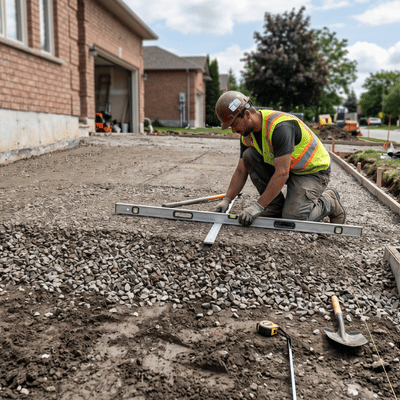
A driveway is only as strong as its foundation. Without proper grading and excavation, water pools, soil shifts, and pavement fails early.
Professional driveway excavation services ensure:
DIY attempts often miss compaction standards or slope requirements. That leads to expensive fixes down the road.
Before any digging starts, your site needs a proper evaluation. Heavy clay soil or buried rock can change how deep excavation needs to go. Most driveways require excavating 8 to 12 inches below finished grade.
An excavation contractor services team will assess:
When a new driveway or driveway apron impacts the public right-of-way, many local governments demand a permit. Jurisdiction-specific requirements vary, but often involve utility marking prior to excavation, a scaled design that shows the position and size of the driveway, and a permission application. Depending on the property and local regulations, some places may also ask for evidence of ownership or HOA approval. A Right of Way permit and a scaled plan are needed for a driveway apron in Montgomery County, Maryland. Approvals are normally granted in two to three weeks.
Here's what to expect when working with professional driveway excavation services:
They took away the old pavement, roots, and trash. Silt barriers and other erosion control measures may need to be put in place by local codes.
This is where the soil is leveled. The equipment digs to the right depth and takes out any organic material that could cause settling. Grading and excavation work together to shape the surface and let water flow away properly.
French drains, trench drains, and culverts are all put in low spots. A lot of counties in Texas require that any new road have a culvert with a minimum diameter of 12 inches. If done right, drainage can protect your foundation for decades.
Crushed stone is put down in layers that are 6 to 8 inches thick and packed down to at least 95% density. This base is what makes your driveway strong. This Old House says that proper compaction makes a foundation that is almost water-tight and supports the layer above it.
The base is fine-graded to fit the design plan. The surface is ready for paving after checking the elevations.
Driveway excavation services can vary a lot based on the size of the driveway, the condition of the soil, access to the site, drainage needs, and the material you plan to install afterward. In most cases, homeowners should expect costs for excavation, base preparation, paving materials, drainage work, and permit-related expenses.
| Excavation and grading | Varies based on site size, soil condition, and depth of work |
| Gravel base material | Depends on the amount of material needed and local supply rates |
| Asphalt paving | Usually lower than concrete, but it depends on thickness and site prep |
| Concrete paving (plain) | Often higher than asphalt due to material and labor demands |
| Drainage components | Can increase if the site needs extra water control measures |
| Permits and fees | Varies by city, county, and project scope |
It is also smart to set aside extra budget for unexpected site conditions, such as buried rock, poor soil, drainage problems, or other issues that only become clear once excavation begins.
Ready to get an accurate number for your project? Contact Shilling Excavation for a free quote today.
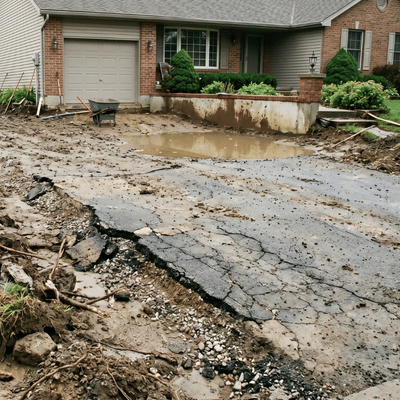
Even small errors during excavation can cause big problems later. Watch out for these:
Excavation contractor services from a licensed professional reduce all of these risks.
Most residential driveways require 8 to 12 inches of excavation below finished grade. This allows room for a compacted gravel base and your chosen paving material.
In most areas, yes. Permits are commonly required for new driveways or major replacements. Contact your local building or highway department before starting work.
Soil leveling is the process of grading the excavated surface to a consistent slope. It ensures water drains away from your home and your paving layer sits evenly.
It usually takes 1 to 3 days to dig up and prepare the base for a standard residential driveway. The full project timeline, which includes getting permits and curing, is between 2 and 6 weeks.
Yes. More and more people are choosing permeable pavers and porous asphalt. The EPA says they are strong and cheap options that can cut down on stormwater runoff by 80 to 90%. For them to work right, they need a slope of 5% or less.
Grading and excavation often go hand in hand. Excavation removes soil to the required depth. Grading shapes and levels that surface to the correct slope and elevation for drainage and paving.
Long before the surface is applied, a long-lasting driveway begins. Every project at Shilling Excavation is constructed on a solid, correctly engineered foundation thanks to years of practical excavation, grading, and site preparation experience. To create driveways that endure and function well in real-world settings, their crew uses expert machinery, tried-and-true techniques, and stringent quality standards.
Avoid drainage problems, cracks, and expensive rework. Get professional driveway excavation done the first time correctly. To arrange your site assessment and secure a strong, long-lasting foundation, give Shilling Excavation a call right now.